

Restorative Dentistry

Restorative dentistry is a specialty of dentistry whose objective is the anatomical and functional restoration of teeth that have suffered irreversible damage, restoring their natural shape, function, and esthetics.
At Dr. Alejandro Martinez’s clinic, we are committed to maintaining the integrity of the largest possible amount of dental tissue of our patients (conservative dentistry), offering the best esthetic results and the greatest longevity of the restorations. This is achieved through the maintenance of biological, mechanical, and functional properties of the enamel and dentin, using ceramic and composite (in the case of dental pieces) as well as cutting-edge enamel and dentin as adhesives.
The restoration consists of the reconstruction of a portion of the tooth which has been irreversibly destroyed, fractured, worn away or affected by cavities. Thus, preventing the progression of disease and the destruction of the tooth until its complete loss. Among the different types of restorations, we offer dental filling, replacement of amalgams with composite, dental crowns, and ceramic inlays.
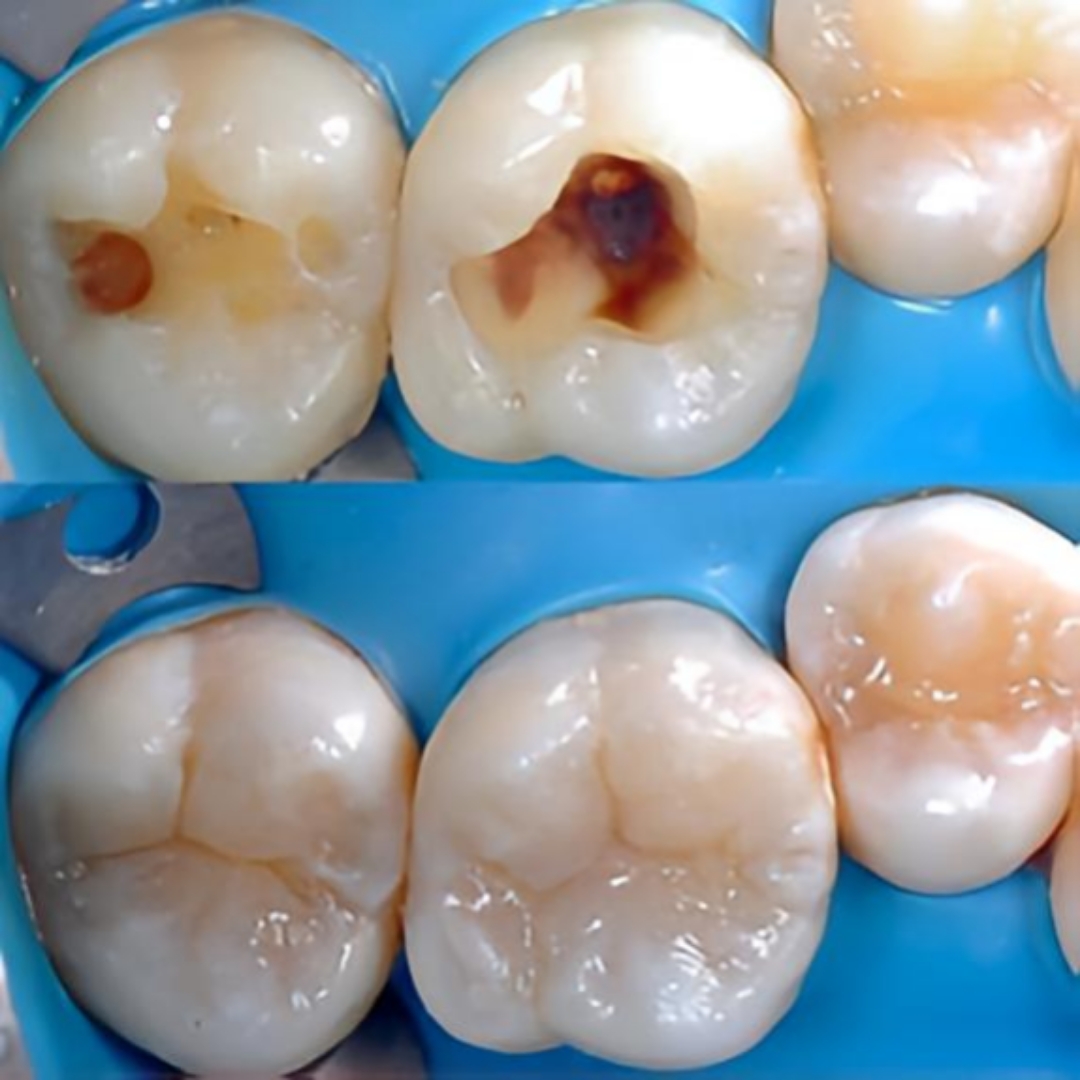
Dental Filling
A dental filling is a direct dental restoration technique in which composite is used to return the shape and function to a tooth that has been damaged by cavities, small fractures or wear. The dental fillings made by our specialists are of high quality and completely esthetic, providing the restoration with the durability, resistance, and natural appearance like that of other teeth.
Replacement of Amalgams with composite
Disadvantages of using amalgams
Previously, restorations were made in amalgam due to its high resistance to chewing force. However, this material has several disadvantages including that they are not esthetic due to their grayish-silver coloration, there is the possibility for mercury contamination (since mercury is one of the components of amalgams), poor adhesion on the edges cause spaces to form between the amalgam and the tooth, and since it retention is mechanical, it requires a larger preparation of the dental surface (i.e., greater extraction of dental tissue), etc.
Our recommendation…
We recommend replacing amalgams with composite, which, in addition to being esthetic, has excellent physical and adhesive properties, allowing the preservation of the greatest amount of tooth structure. Sometimes, it might be necessary to take an x-ray prior to the replacement, to assess the size and depth of the amalgam.


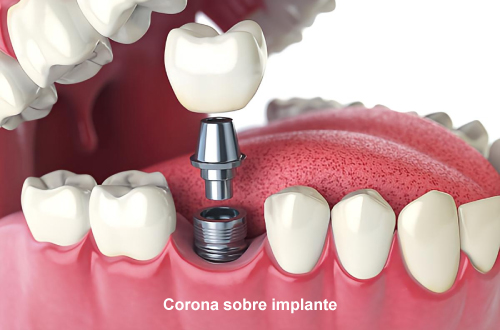
Dental Crowns and Fixed Bridges
What are they?
A crown is a metal-free piece made of zirconium and/or lithium disilicate ceramic, which can be used to restore a tooth individually or to form part of a fixed bridge (when one or more teeth have been lost). The fixed crown or bridge can be placed on a tooth stump (which has been worn away, but part of its structure has been preserved) or on a titanium implant in case of total tooth loss. Both alternatives are very useful to restore functionality in case of loss of teeth, however, the choice of treatment will depend on the needs of the patient and the clinical concept of the specialist.
What are the advantages of using fixed crowns and bridges made of zirconium?
Zirconium is a light and highly resistant material, 100% biocompatible with the human body, so it does not cause allergies or any type of adverse reaction. Fixed crowns and bridges made of zirconium do not change color over time, are highly esthetic and easily blend in with the teeth, since zirconium is a mineral that has excellent optical properties, that perfectly simulate the natural structure of teeth.
What care should I have?
In case of bruxism, the use of protective sleeves is recommended to avoid exerting strong pressure on the crown or bridge, causing it to wear or fracture. It is recommended to maintain good oral hygiene to avoid the appearance of cavities, pulp infections, and periodontal diseases that may affect the stump on which the crown or bridge is supported. In addition, you should avoid eating hard foods, uncovering containers with teeth, etc.
Ceramic inlay
What is it?
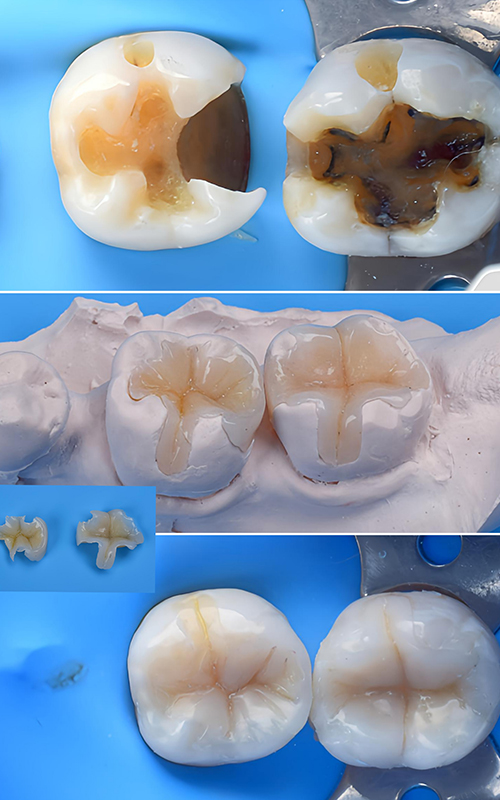
It is the minimally invasive way to restore or rehabilitate posterior teeth, molars or premolars that have lost much of their structure, without wearing down the tooth or making a crown. The inlays are made of vitreous ceramic, providing color stability and great mechanical resistance to wear and fracture, which is why over time they have replaced the use of crowns when the tooth is not excessively deteriorated.
What advantages does it present?
- Ceramic inlays are esthetic, durable, and highly resistant to wear.
- They are completely biocompatible with dental tissues.
- They present the same or greater mechanical resistance than a natural integral tooth.
- They accumulate a lower degree of bacterial plaque compared to other materials and blend very well with the tooth, being imperceptible to the naked eye.
When is it recommended to make a ceramic inlay?
A ceramic inlay is recommended under the following circumstances:
- Extensive cavities
- After an endodontic procedure
- Removal of amalgam or previous large-surface dental filling
- Tooth fracture
- Acute tooth wear
- Fissure product of malocclusion (misaligned teeth)
Absolute isolation and dental microscope
We are one of the only clinics in Colombia to perform cementation (adhesion) and inlay adaptation using the DENTAL MICROSCOPE under absolute isolation. The use of this technology allows us to clearly see every detail of the process, guaranteeing precision in adjustment (adaptation), polish, and shine.

Cra 40b # 5b-15
ALMASUR Centro Profesional
Cali – Colombia